From Outdated to On Trend: How the Semicolon Found a New Voice in the Age of Social Media
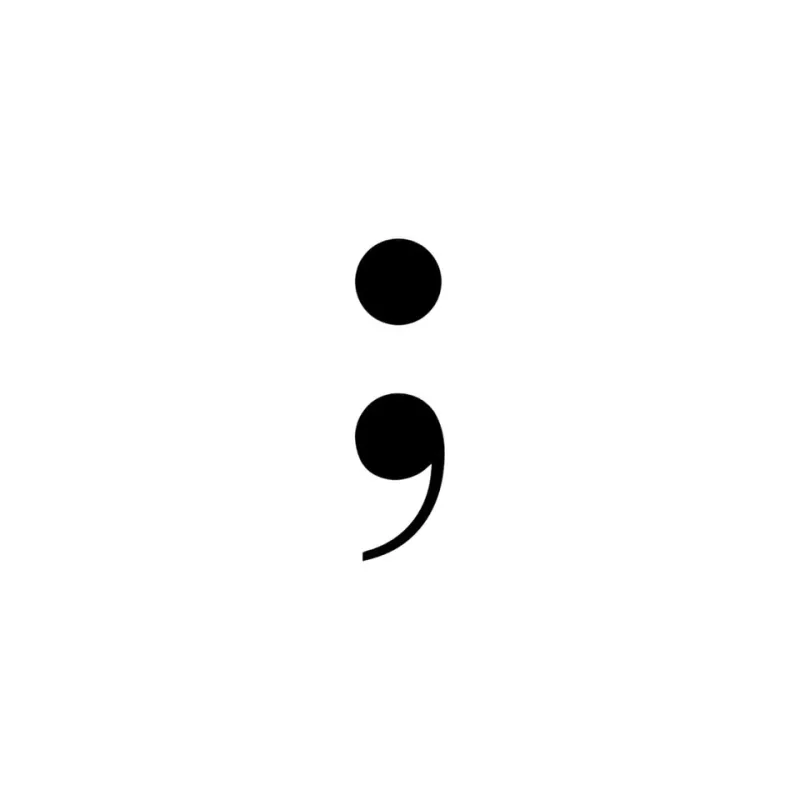
Photo: Altair Netraphim, CC BY 4.0, via Wikimedia Commons
For decades, the semicolon occupied a peculiar corner of the English language — technically correct, theoretically useful, and almost universally avoided. Writing instructors warned students not to overuse it. Style guides buried it under caveats. Even accomplished authors admitted they found it intimidating. Kurt Vonnegut once declared that semicolons were "transvestite hermaphrodites representing absolutely nothing" and advised writers to avoid them entirely.
And yet, here we are in the mid-2020s, watching the semicolon stage what can only be described as a quiet comeback — not in academic journals or legal briefs, but in the captions of viral TikTok videos, the threads of deeply personal Twitter posts, and the opening pages of debut literary fiction written by authors under thirty.
Something is happening to the semicolon; and it is worth paying attention to.
What the Semicolon Was Always Supposed to Do
Before examining where the semicolon is going, it helps to understand where it came from. In traditional prescriptive grammar, the semicolon serves two primary functions. First, it joins two independent clauses that are closely related in thought — clauses that could stand alone as separate sentences but benefit from being linked. Second, it separates items in a list when those items already contain commas, a usage sometimes called the "super comma."
Both functions are genuinely useful. A sentence like She had been awake for thirty-six hours; she was not going to apologize for the coffee carries a different rhythm and emotional weight than its period-separated counterpart. The semicolon signals a relationship between those two thoughts without spelling it out — a kind of punctuated implication.
The problem, historically, was that this subtlety made the semicolon feel inaccessible. Writers who were unsure whether their clauses were truly independent, or whether the connection was strong enough to warrant a semicolon rather than a period, simply reached for something else. The comma splice became common. The em dash surged in popularity. And the semicolon retreated further into the margins of everyday writing.
Enter Gen Z — and a Very Different Relationship with Punctuation
Anyone who has spent time reading the comments sections of social media platforms has likely noticed that younger writers use punctuation in ways that do not always align with traditional instruction. Periods at the end of text messages have been widely interpreted as cold or passive-aggressive. Ellipses signal hesitation or sadness rather than omission. And the semicolon — that formerly stiff, academic mark — has taken on a new, emotionally resonant quality.
Consider the way semicolons appear in personal essays and social media posts authored by Gen Z writers. Rather than using them to join independent clauses in the technical sense, these writers deploy them to create a sense of pause that is heavier than a comma but more intimate than a period. The effect is a kind of breathlessness, a sense that the thought is not quite finished but needs a moment before continuing.
A TikTok caption might read: I thought I was fine; I was not fine. A Twitter thread about mental health might begin: Some days are harder than others; today was one of those days. These constructions are, by traditional standards, grammatically correct — but the motivation behind them is not correctness. It is feeling.
This distinction matters enormously from a language and culture perspective. The semicolon is no longer being used merely to demonstrate grammatical competence. It is being used as a stylistic instrument, chosen deliberately to shape the reader's emotional experience.
The Semicolon as a Marker of Identity
There is also a cultural dimension to this shift that deserves acknowledgment. The semicolon carries symbolic weight in certain communities, particularly among those who have engaged with mental health advocacy. Project Semicolon, a nonprofit organization founded in 2013, adopted the mark as a symbol of continuation — the idea that a story is not over, that a sentence continues rather than ends. For many young people, the semicolon carries that association into their writing, whether consciously or not.
This layering of meaning — grammatical, stylistic, and symbolic — gives the semicolon a richness in contemporary usage that it never quite had in its more formal applications. When a twenty-two-year-old writer places a semicolon in the middle of a personal essay about loss or uncertainty, they may be making a grammatical choice, an aesthetic choice, and an emotional statement all at once.
Emerging literary fiction reflects this tendency as well. Debut novelists in their twenties and early thirties are using the semicolon with a frequency and intentionality that older style guides might find puzzling. Rather than separating neatly parallel independent clauses, these writers use the mark to create syntactic tension — to hold two ideas in proximity without fully resolving the relationship between them.
Prescriptive Grammar Meets Linguistic Evolution
This is, of course, where grammarians begin to feel uneasy. Prescriptive grammar — the tradition of establishing and enforcing formal rules — exists for good reasons. Shared conventions allow writers and readers to communicate efficiently and accurately. When punctuation marks acquire fluid, context-dependent meanings, some degree of precision is inevitably lost.
And yet, descriptive linguistics — the practice of observing how language actually functions in real communities — reminds us that rules have always evolved. The comma itself has shifted considerably over centuries of use. The apostrophe has been contested for generations. Language is not a fixed system handed down from a neutral authority; it is a living practice shaped by the people who use it.
The question for educators and writing professionals is not whether Gen Z's relationship with the semicolon is right or wrong by some absolute standard. The more productive question is: what does this shift reveal about how contemporary writers understand rhythm, emotion, and connection in written language?
What This Means for Writers Today
For students and professionals working to strengthen their writing, the semicolon's cultural moment offers a useful lesson. Learning the traditional rules is still essential — knowing how and why a semicolon joins independent clauses gives you a foundation from which to make deliberate choices. But rigid adherence to convention, without attention to voice and effect, produces writing that is correct but lifeless.
The most compelling writers — across generations and genres — use punctuation purposefully. They understand the rules well enough to know when following them serves the work and when bending them does. The semicolon, it turns out, is an excellent case study in that balance.
So the next time you encounter a semicolon in an unexpected place — tucked into a social media caption, breathing quietly in the middle of a personal essay — consider what it is doing there. It may not be following the rulebook; but it may be saying something the rulebook never quite figured out how to express.