Always On, Never Focused: What Constant Notifications Are Doing to Your Writing Voice
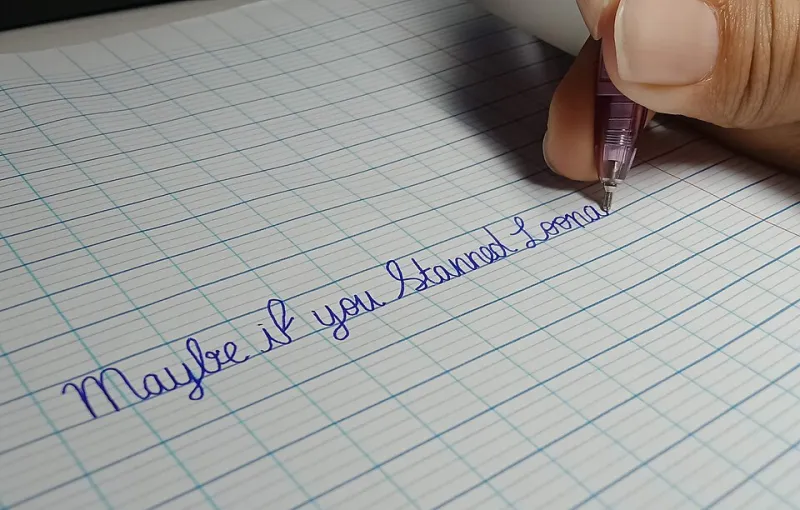
Photo: Jiafei Slay Queen, CC0, via Wikimedia Commons
You sit down to draft a report, a proposal, or even a carefully worded email. Three sentences in, your phone lights up. A Slack message. A calendar reminder. A news alert from an app you forgot you installed. By the time you return to the document, something has shifted — not just your concentration, but the rhythm, tone, and authority of the words themselves.
This is not a productivity complaint. It is a grammar and writing problem, and it deserves to be treated as one.
The Brain Does Not Multitask — It Switches, and Switching Costs You
For years, multitasking was celebrated as a professional virtue. Research has since dismantled that myth thoroughly. Neuroscientists at the University of California, Irvine found that it takes an average of more than twenty-three minutes to fully regain deep focus after a single interruption. That figure is worth sitting with for a moment.
When you are writing in a state of genuine concentration — what psychologist Mihaly Csikszentmihalyi termed "flow" — your brain is engaged in a remarkably complex operation. You are holding your argument's structure in working memory, monitoring your tone for consistency, selecting vocabulary that suits your intended audience, and tracking the syntactic patterns of your sentences simultaneously. The moment a notification pulls even a fraction of your attention away, the cognitive scaffolding supporting all of those tasks begins to collapse.
What appears on the page afterward is not simply a continuation of what came before. It is the work of a slightly different mental state — one that must reconstruct context, reestablish tone, and remember where the argument was headed. The result, for many writers, is prose that reads as though it were written by two different people.
What Fragmented Attention Looks Like on the Page
The symptoms of interrupted writing are recognizable once you know what to look for. Sentence length becomes erratic — long, well-developed constructions give way abruptly to clipped, declarative statements that feel out of place. Transitions weaken or disappear entirely, leaving paragraphs that sit beside each other without logical connection. Word choice grows inconsistent: formal register in one passage, casual phrasing in the next.
Perhaps most damaging is the loss of narrative momentum. Strong writing, whether analytical or persuasive, builds toward something. Each sentence advances a claim, deepens an argument, or earns a conclusion. Interruption-driven writing tends to restart rather than advance. Ideas are reintroduced rather than developed. The reader senses the disruption even if they cannot name it — and when a reader loses trust in the voice guiding them through a document, they disengage.
For professionals, this carries real consequences. A fragmented memo signals unclear thinking. A proposal that shifts tone mid-section raises doubts about the writer's command of the subject. A cover letter that loses its thread in the second paragraph rarely survives to a second reading.
The Notification Economy and the Writing Life
The American workplace has normalized a state of perpetual availability that is, from a writing standpoint, deeply hostile to quality output. Corporate messaging platforms such as Slack and Microsoft Teams were designed around the assumption of near-instant response. Email inboxes refresh automatically. Smartphones sit face-up on desks, their screens flickering with incoming information every few minutes.
Technology companies have invested enormous resources into making their notifications feel urgent and rewarding. Each alert triggers a small dopamine response — a neurological nudge that conditions users to check, respond, and check again. The result is a baseline state of anticipatory distraction, in which even the absence of a notification carries a cognitive cost because part of the brain remains on alert for the next one.
This environment is incompatible with the demands of serious writing. It is not a matter of willpower or discipline. It is a structural conflict between how attention-capture technology operates and how coherent prose is produced.
How Accomplished Writers Are Protecting Their Focus
Authors, journalists, and communication professionals who produce consistently high-quality written work tend to share one practice: they treat uninterrupted writing time as non-negotiable. The specific methods vary, but the underlying principle is consistent — deep writing requires deliberate protection from the ambient noise of the connected world.
Some writers schedule what productivity researcher Cal Newport calls "deep work blocks" — stretches of two to four hours during which all notifications are silenced, devices are placed out of reach, and the browser is closed or restricted. Others adopt a time-blocking approach, designating the first ninety minutes of the workday exclusively for writing before engaging with messages or meetings.
There is also growing adoption of analog tools within digital workflows. Drafting initial content by hand, for instance, removes the temptation to switch applications and forces a slower, more deliberate engagement with language. Many professional writers report that handwritten first drafts produce more consistent voice and cleaner structure than those composed directly on a screen.
Some organizations have begun implementing "quiet hours" — designated periods during which messaging platforms are muted and response expectations are suspended — to support employees who must produce complex written deliverables as part of their roles.
Practical Strategies for Reclaiming Your Writing Voice
If you recognize the fragmentation described above in your own writing, the following approaches offer a structured path toward recovery.
Audit your notification settings. Most smartphones and computers allow granular control over which applications can interrupt you and when. Conduct a deliberate review and disable all non-essential alerts during your identified writing periods. The default settings on most devices are calibrated to maximize engagement, not your cognitive performance.
Establish a pre-writing ritual. Before beginning a writing session, spend five minutes reviewing your outline, purpose, and intended audience. This practice loads the relevant context into working memory and reduces the cognitive reconstruction required if a brief interruption does occur.
Write in complete drafts before editing. One of the most effective ways to preserve voice consistency is to complete a full draft — however rough — before returning to revise. Editing mid-draft invites the same kind of attention switching that notifications produce, and it interrupts the forward momentum that gives writing its coherence.
Read your work aloud before submitting it. The ear detects tonal inconsistency more readily than the eye. Reading aloud forces you to move through the prose at the pace a reader would, making interruption-induced shifts in register and rhythm immediately apparent.
Protect your best hours. Most people have a period of the day during which their cognitive performance peaks. Identify yours and reserve it exclusively for writing. Reserve lower-energy periods for responding to messages, attending meetings, and handling administrative tasks.
A Voice Worth Protecting
Your writing voice is not merely a stylistic preference. It is the primary instrument through which you communicate credibility, intelligence, and authority to every reader who encounters your work. Allowing that voice to be fractured by the relentless rhythm of digital notifications is not an inevitability — it is a choice, and one that can be reversed.
The notifications will always be there, ready to reclaim your attention the moment you permit them to. The question is whether you are willing to defend the time and focus that coherent, authoritative writing genuinely requires. Your readers — and your professional reputation — are counting on that defense.